

Sargam Music
Sarod
A quality musical product designed for smooth performance, reliable use and a better music experience.
Rs. 0
Rs. 0
Today's Special
Special offer —
₹500 off
applied on this product. No coupon code needed!
Couldn't load pickup availability
Notified by email when this product becomes available

Sarod
Rs. 0.00
Context
- Sarod maestro Pandit Rajeev Taranath passes away.
Sarod
Instrument Family:
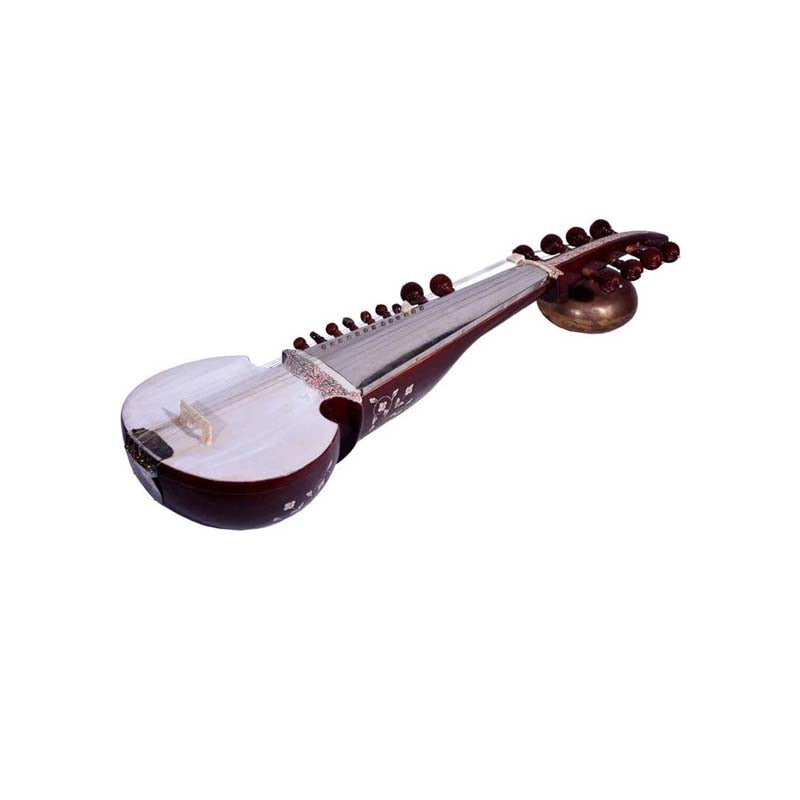
- The sarod is a stringed instrument belonging to the lute family.
- It is widely recognized and cherished in Hindustani classical music for its rich, expressive sound.
Sound Characteristics:
- The sarod produces a deep, heavy sound with a resonant quality that is enhanced by its sympathetic strings.
- It is particularly noted for its ability to perform sliding pitches, known as meend or glissando, which are often used in the introductory sections of many ragas.
Physical Description
Length:
- The sarod is typically 100 cm (39 inches) long, making it a sizeable and imposing instrument.
Body Material:
- The body is made from hollow teak, sagwan, or tun wood, contributing to its distinct sound quality.
- High-quality sarods are crafted with the body, neck, and peg box from a single piece of wood, ensuring structural integrity and superior acoustics.
Resonator:
- The resonator of the sarod features a stretched membrane, usually made from goatskin, which helps produce its characteristic deep sound.
- The strings rest on a bridge made from horn, adding to the instrument's unique tonal qualities.
Neck:
- The neck of the sarod is distinguished by its polished steel plate, rather than a traditional wooden fretboard, allowing for the unique playing techniques associated with the instrument.
Strings:
Sarods typically have between 17 to 25 strings, divided as follows:
- 4 to 5 melody strings, which are the primary strings used for playing the main musical lines.
- 1 to 2 drone strings, which provide a continuous harmonic background.
- 9 to 11 sympathetic (tarab) strings, which resonate sympathetically with the melody strings to enrich the overall sound.
- Historically, the strings were made from gut or silk, but modern sarods usually use steel or bronze strings for durability and brightness.
History of the Sarod
Origins:
- The sarod is based on the Afghan rabab, an instrument developed in the 10th century.
- The rabab influenced many bowed string instruments across Europe and Asia.
Influences:
- The sarod was also influenced by the Chitra veena, a 21-string fretless lute described in Bharata’s Natya Shastra around 200 BCE.
- The name sarod is derived from another ancient instrument, the Sharadiya veena.
Evolution in India:
- The rabab was introduced to India in the 16th century.
- Over the next 200 years, it gradually evolved into the modern sarod, with notable changes in its construction and playing technique.
- Significant changes included the use of different wood types and the introduction of a steel-plated neck instead of a wooden fingerboard.
- Unlike the rabab, which is played with a bow, the sarod is played by plucking the strings, resulting in a distinct sound.
Popularity:
- The sarod gained prominence in Northern India during the 1800s.
- It was further refined and popularized in the 20th century by virtuosos like Allauddin Khan.
Sarod Playing Techniques
Fretless Neck:
- The absence of a fretboard means players must press the strings firmly against the polished steel neck.
String Stopping:
- Players use the tips of their fingernails or fingertips to stop the strings, allowing for precise pitch control and the execution of sliding pitches (meend).
Notable Sarod Players
Allauddin Khan:
- Allauddin Khan is a legendary figure who made significant contributions to the development and adaptation of the sarod in the 20th century.
- He was a master of the instrument and a teacher to many notable musicians, thus greatly influencing the sarod tradition.
Other Influential Players:
- Amjad Ali Khan: One of the most famous sarod players, known for his virtuosic technique and deep understanding of ragas.
- Ali Akbar Khan: Son of Allauddin Khan, he was instrumental in popularizing the sarod internationally.
- Aashish Khan: Grandson of Allauddin Khan, known for his innovative approach and fusion collaborations.
- Buddhadev Das Gupta: Renowned for his technical mastery and emotive performances.
- Sharan Rani: One of the first female sarod players to gain prominence, contributing significantly to the instrument’s repertoire and pedagogy.
- These notable players have not only maintained the rich tradition of sarod playing but have also pushed its boundaries, bringing new dimensions to Hindustani classical music.